
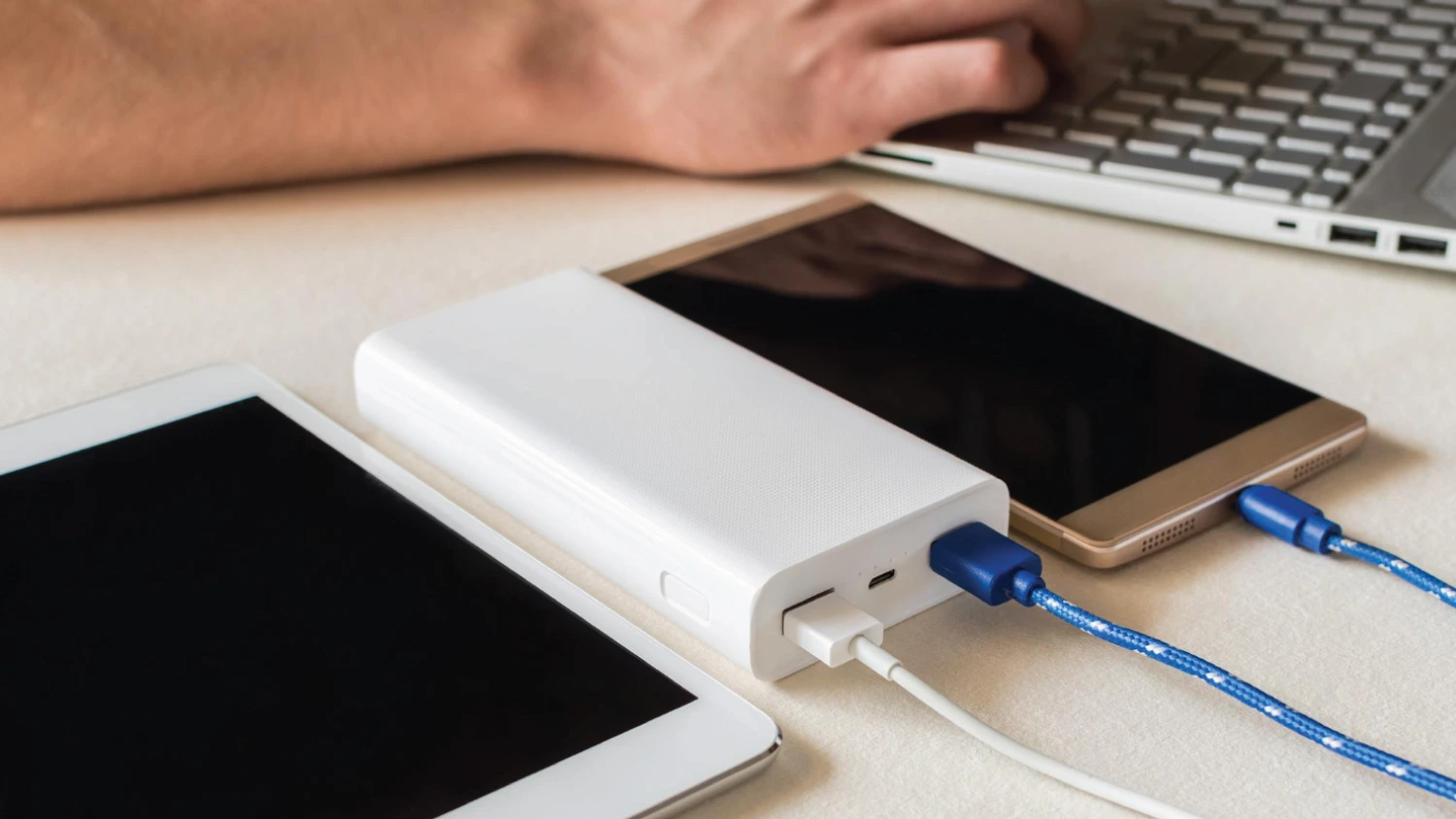
Why fast charging and the right power bank matter
Phones, tablets, and laptops now demand much higher and smarter power delivery. Fast-charging standards (USB-PD, PD 3.1, PPS) and high-wattage portable banks let you top up a flagship phone in minutes or keep a laptop running between meetings. Meanwhile, GaN (gallium nitride) chargers compress high wattage into small, travel-friendly bricks – a game-changer for road warriors and hybrid workers. For reference, recent industry reviews highlight 140W-capable portable power banks and 100–140W GaN wall chargers as top performers for modern devices.
At-a-glance buying-outline (what to compare)
Use this checklist when scanning specs and reviews:
- Capacity (mAh / Wh) – Higher mAh = more full charges; for air travel, check Wh limits (≤100 Wh allowed in-cabin).
- Max output (W) – Phones: 18–65W is common; Laptops: 65–140W depending on model.
- Ports & protocol – USB-C PD (preferably PD 3.0 / 3.1), PPS for Samsung/Android fast charging, at least one high-watt USB-C.
- GaN vs silicon – GaN is smaller and cooler for equivalent wattage.
- Pass-through charging – Charge bank while charging devices (handy but some models heat up).
- Safety features – Overheat, overcurrent, short-circuit protection, certified cells.
- Size/weight and recharging time – Bigger capacity is heavier and takes longer to recharge; look for PD input for faster top-up.
Top picks – categories & quick notes
(These picks represent the kinds of products frequently recommended in 2024–2025 reviews and remain excellent examples to consider.)
Best high-watt portable power bank (laptop + phone)
Anker 737 (PowerCore 24K) – 24,000 mAh, up to 140W output for laptops, display that shows real-time power. Great balance of capacity and high-watt performance.
Best compact power bank (pocket-size phone charger)
Small high-density models (lipstick-sized or 10k mAh) from established brands are ideal for day trips – look for PD 20–30W support and solid safety certifications. (Examples frequently appear on “best of” lists.)
Best GaN wall charger (multi-port)
UGREEN Nexode / UGREEN Nexode Pro (100W+ variants) – compact GaN chargers with multiple USB-C ports that can feed a laptop and phone simultaneously. GaN models from Anker, UGREEN, and other reputable makers offer 65–140W options.
Best travel / all-in-one charging hub
Chargers that combine AC outlets + multiple USB-C PD ports (some up to 140W on a single port) are excellent for hotel desks and deskside setups – look for intelligent power distribution and a strong thermal design.
Detailed buying guide (capacity, wattage, ports, safety)
Capacity and airport rules
Power banks list mAh, but airlines and safety rules use Wh (watt-hours). To convert: Wh = (mAh × Voltage) ÷ 1000. Most phone power banks are rated at 3.7V cell voltage. Keep banks ≤100 Wh in carry-on to comply with most airline rules (larger banks may need airline approval).
Wattage: match the device
- Smartphones: Modern phones benefit from 18–45W; flagships may take 65W in short bursts.
- Laptops: Many ultraportables accept 45–65W; power-hungry machines (16–14″ pros) need 100–140W for full-speed charging. If you plan to charge a laptop, buy a bank/charger that advertises PD 3.1 / 140W support. Recent portable banks like the Anker 737 demonstrate how high-watt banks power laptops in the field.
Ports & simultaneous charging
If you travel with multiple devices, choose a charger with multiple high-watt USB-C ports that intelligently distribute power. Note that combined maximum wattage often drops when multiple ports are used simultaneously.
GaN technology
GaN lets chargers handle high wattage in a much smaller footprint. For everyday carry, a 100W GaN charger can replace several bricks and is recommended for business travelers.
Safety & build quality
Prefer brands with recognized safety certifications and multi-layer protection. Recent recalls of low-cost models underline the importance of buying from reputable sources and checking recall notices.
Extra features to consider
- LCD/OLED status screens for real-time output/readout.
- Pass-through charging if you need the convenience of charging the bank and devices at once.
- Foldable plugs / travel adapters for compactness.
- Warranty & support – longer warranty often indicates manufacturer confidence.
Real-world use cases: which model for which user
- Daily commuter / phone-first user: Small 10k–20k mAh bank with 20–30W PD and a compact 30–65W GaN wall charger for home.
- Hybrid worker / laptop user: 65–100W PD wall charger + 20–24k mAh power bank with 65–140W output (to keep laptop topped up between meetings). The Anker 737-style banks that support 140W suit this case.
- Traveler / photographer: Lightweight, high-capacity bank (20k+ mAh) with multiple ports and a 100–140W GaN charger so you can refill batteries, phones, and a laptop from a single compact brick.
- Power user / multi-device family: Multi-port charging hub (AC + USB-C PD ports) with smart distribution and at least one high-watt USB-C port.
Maintenance, safety & charging etiquette
- Avoid extreme temperatures – heat shortens battery life and can trigger protections.
- Use good cables – PD 3.1 high-watt charging needs rated USB-C cables (look for 240W-rated cable for PD 3.1/140W scenarios).
- Don’t ignore recalls – check manufacturer pages if you hear news about a model; safe disposal instructions matter.
- Periodically top-up – Li-ion cells degrade if left at 0% for long periods; keep banks around 40–70% for long-term storage.
FAQs
Can a phone be damaged by using a high-watt power bank or charger?
No — devices negotiate power using USB-PD or proprietary protocols. The source (charger/power bank) offers power only after negotiation. Use certified, reputable chargers and cables to avoid faulty negotiation.
What’s the difference between PD 3.0 and PD 3.1?
PD 3.1 introduces higher maximum voltages and wattages (enabling 140W+ charging) and better negotiation for laptops. If you need laptop-level speed from a small charger or bank, look for PD 3.1 support.
How many times will a 20,000 mAh bank charge my phone?
Rough estimate: divide bank mAh by phone battery mAh and multiply by ~0.7 (conversion and efficiency losses). So a 20,000 mAh bank ≈ 0.7× (20,000 ÷ 4,500) ≈ 3 full charges for a 4,500 mAh phone.
Is GaN worth the extra cost?
Yes, for portability and efficiency. GaN chargers offer the same or higher wattage in a smaller package and generally run cooler.
Are high-watt power banks legal on flights?
Most airlines allow power banks ≤100 Wh in carry-on. Always check airline rules and the bank’s Wh rating. Larger banks may require airline approval. (Tip: manufacturers often list Wh or airline compliance in specs.)
Can I use pass-through charging safely?
Many modern banks support it, but it can generate heat and slightly reduce efficiency. Use it sparingly and avoid heavy loads while pass-through charging.


